

The Social Contract Is Being Datafied
India’s Digital Infrastructure as a Preview of Algorithmic Governance

For most of modern history, the relationship between citizens and the state was mediated through institutions.
If you wanted access to welfare, credit, mobility, or documentation, you interacted with people; clerks, officers, caseworkers, agents. Decisions involved paperwork, queues, interviews, and occasionally, discretion. Governance had friction. It took time.
But that friction also created space for agency:
You could explain your situation.
You could appeal a decision.
You could escalate your case.
You could ask for context to be considered.
Now imagine replacing many of those human checkpoints with digital systems that rely on data and algorithms.
India offers one of the most advanced real-world case studies of what happens when governance becomes a software-mediated coordination layer, not through sweeping political reform, but through infrastructure upgrades.
Over the past decade, India has built national-scale digital public infrastructure (DPI) that includes:
Aadhaar for identity
UPI for payments
DigiLocker for document storage
DigiYatra for airport access
CIBIL for creditworthiness
Each of these systems reduces coordination costs. Together, they begin to reshape how access to opportunity is determined.
From Institutional Interaction to Data-Driven Access
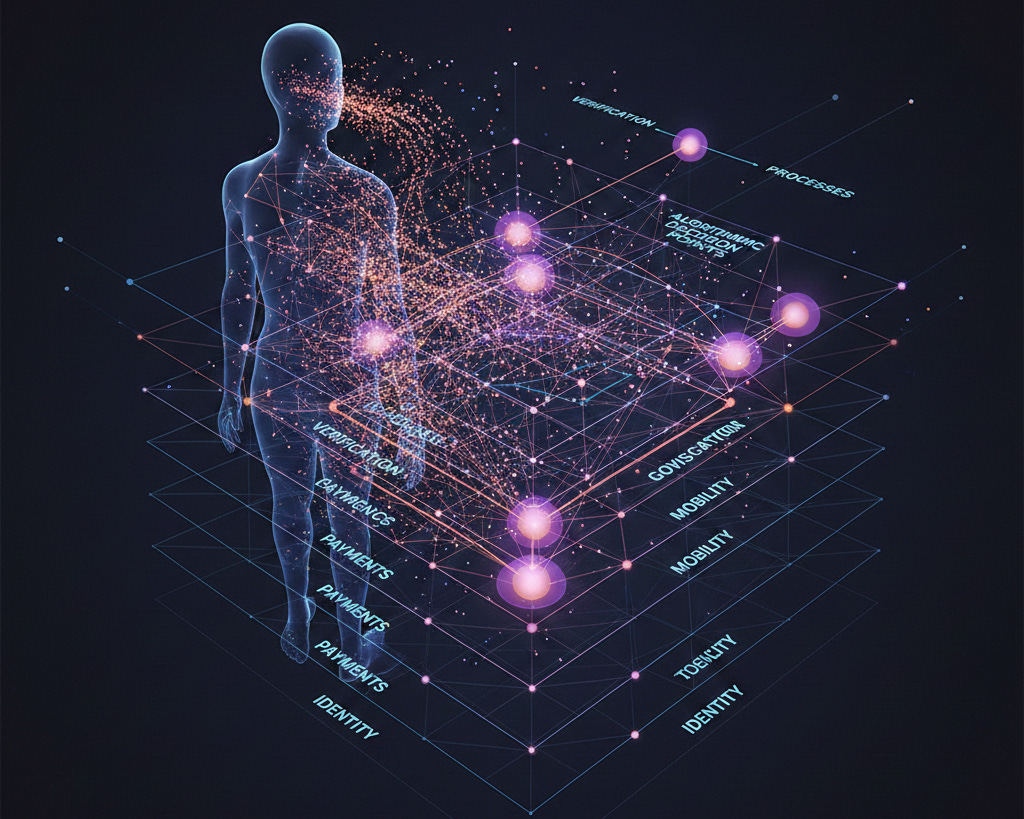
Opening a bank account, applying for a loan, accessing a subsidy, or even boarding a flight now often involves a chain of digital verifications:
Your Aadhaar number confirms your identity.
Your CIBIL score reflects your financial history.
Your UPI transactions reveal spending patterns.
Your DigiLocker documents validate your credentials.
Your biometric profile may clear you through airport security via DigiYatra.
In this system, your eligibility for services is no longer mediated primarily through human interaction, but through:
Verified identity records
Transaction histories
Document authenticity checks
Risk-scoring algorithms
Behavioral data patterns
Decisions that once depended on institutional discretion increasingly depend on whether your data aligns with predefined algorithmic thresholds.
This is governance through classification.
Digital Infrastructure as a Global Trend
India’s DPI ecosystem has enabled:
Instant subsidy transfers
Portable identity verification
Digital onboarding for financial services
Contactless mobility at airports
Paperless document access
But similar shifts are emerging globally:
Credit scoring systems influencing employment access
Health data informing insurance premiums
Digital payment histories shaping loan eligibility
Platform ratings affecting gig work opportunities
As more countries digitize governance infrastructure, data becomes the substrate through which access is negotiated.
Algorithms become gatekeepers.
Private Verifiers and the Capture of Civic Flow
Digital systems rarely operate in isolation.
Banks, fintech apps, payment service providers, telecom operators, and insurance platforms act as private verifiers, authenticating identity, processing payments, and retrieving documents on behalf of public systems.
They enable governance to function smoothly at scale.
In systems terms, they serve as digital lubricants — reducing friction in how money, credentials, and permissions move between citizens and institutions.
But this lubrication is mediated through privately designed interfaces.
These interfaces determine:
What data is requested
How consent is structured
Which options are pre-selected
What defaults are applied
How exceptions are handled
Public infrastructure begins to flow through private pipes.
And private pipes are optimized for usability, engagement, or efficiency, not necessarily for participatory governance.
Ripe for an AI Upgrade
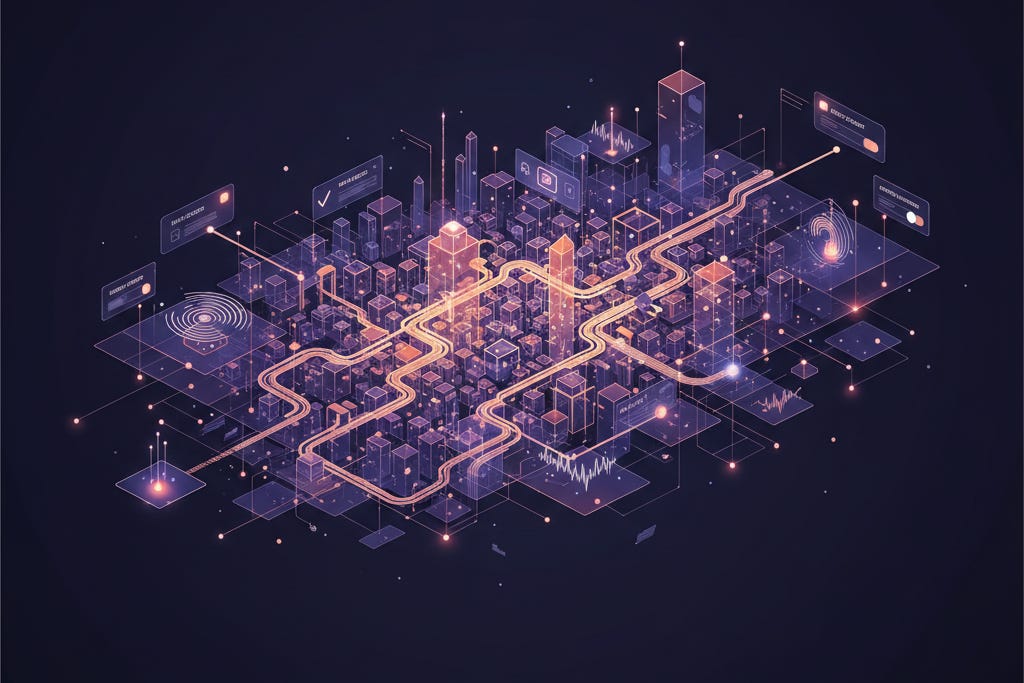
Most of today’s digital governance systems rely on:
Rule-based eligibility criteria
Pattern-matching fraud detection
Threshold-driven risk scoring
Static classification frameworks
These are data-rich environments, which makes them prime candidates for AI-driven optimization.
In the near future, we may see:
Dynamic welfare eligibility updates
Real-time creditworthiness adjustments
Continuous insurance premium recalibration
Automated compliance monitoring
Predictive public service delivery
From an efficiency standpoint, this is compelling, but from an agency standpoint, it introduces new risks.
Because as decision pipelines become more automated:
Appeals may require technical literacy
Eligibility logic may become opaque
Data errors may propagate silently
Oversight may shift into backend systems
And governance may begin to operate through parameters that are difficult for citizens to observe or contest.
The Tech Literacy Imperative
India’s experience offers a glimpse into the future of governance worldwide.
As digital infrastructure becomes more prevalent:
Civic participation may involve navigating consent dashboards
Rights may depend on data accuracy
Access may hinge on algorithmic classification
Representation may require technical understanding
Preventing abuse in such systems will depend not only on policy — but on public awareness of how data and algorithms shape access to services.
Tech literacy becomes a civic skill. Not just in India, but globally.
Because when governance is mediated through software:
Agency depends on understanding the system.
Accountability depends on observability.
Democracy depends on participation in design and oversight.
The social contract is no longer enforced solely through institutions.
It is increasingly negotiated through data flows and implemented through algorithms. Understanding them may be the first step toward governing them.
As governance systems become more data-rich, and increasingly AI-mediated, societies have a narrow window to build the technical literacy needed to meaningfully participate in their evolution.
Because the next upgrade to governance might not arrive as legislation but as a software update.
Great. A country with a class-based culture and history of oppression of minorities can now automate such oppression. What could go wrong?